A feat of manufacturing engineering: 4 x 7,000 operating hours per year
Eugen Seitz manufactures high-tech valves for industrial applications, made predominantly from aluminium and, in some cases, chromium-nickel steel. Two manufacturing cells, each comprising two HELLER HF 3500 machining centres with flexible Goodj automation, operate around the clock to produce frequently changing small batches. The specialists at Eugen Seitz have refined the machining process to such an extent that each of the four HELLER machining centres achieves 7,000 hours of spindle running time per year – out of a theoretical maximum of 8,760 hours. This article also reveals what the team’s wish to go on a skiing holiday together had to do with achieving 150 hours of unattended production.
Can 7,000 hours of spindle running time per machine per year really be achieved in flexible small-batch production? The answer is a resounding yes. Eugen Seitz AG invested in two flexible manufacturing cells in 2021 and 2025. Each comprises two HELLER HF 3500 5-axis horizontal machining centres with fully autonomous, flexible Goodj automation. The flexible manufacturing cells were designed from the outset to achieve 7,000 operating hours per year – a target they have even exceeded in some cases. The company has also achieved another remarkable benchmark in unattended production. Working together with Goodj and HELLER, the specialists at Eugen Seitz AG have refined the manufacturing cells to such an extent that they can operate unattended for up to 150 continuous hours. But more on that later.
Always aiming higher
For the team led by Thomas Girelli (COO, Eugen Seitz AG), there is always room to push a little further – after all, they have even managed to achieve 7,700 operating hours in a single year. With a production team of just ten people, including CAM programmers, the company operates five machining centres and three turning centres on a single-shift basis over a five-day working week.
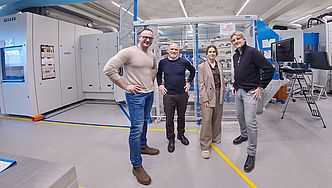
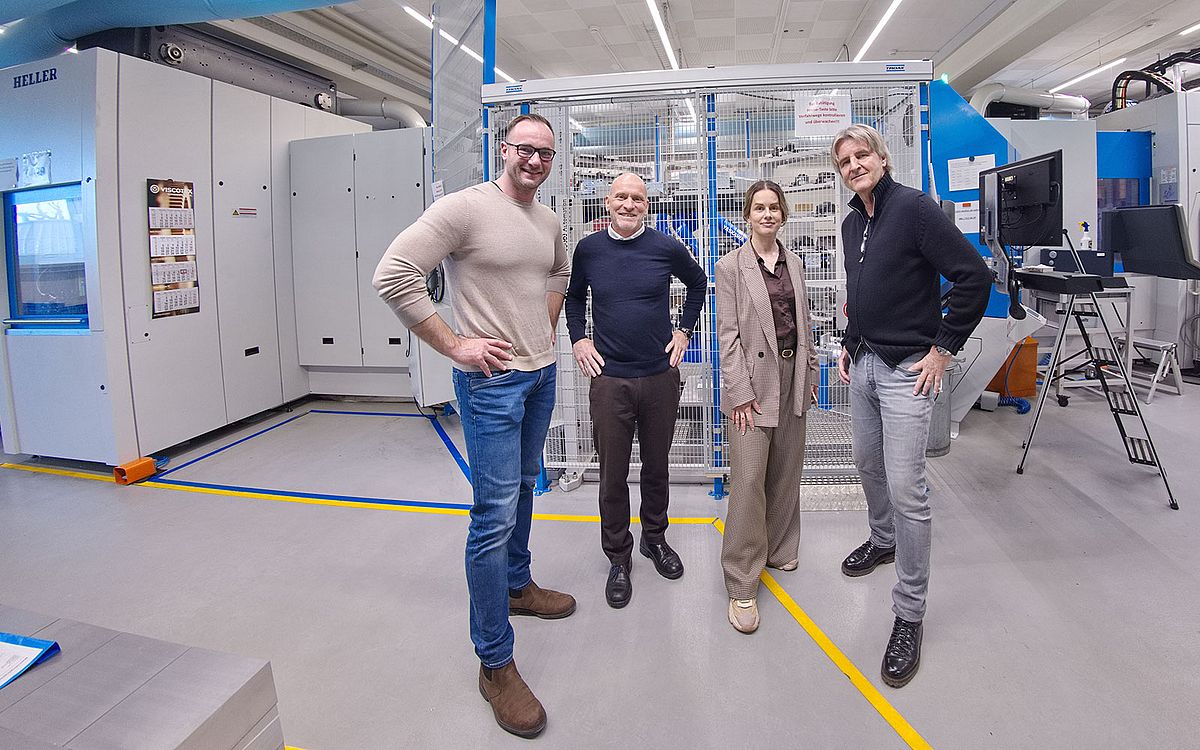
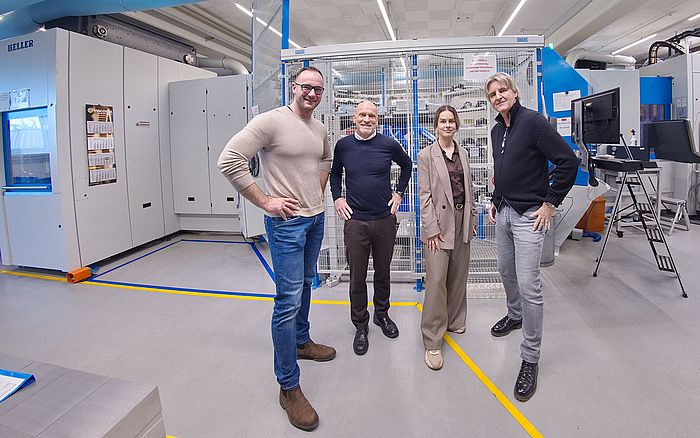
The Eugen Seitz team is constantly looking for ways to optimise every aspect of production. What the specialists in Wetzikon have achieved with four HELLER machines and Goodj automation is nothing short of outstanding. Thomas Girelli (COO) and Tobias Fischer (Operations Manager), both of Eugen Seitz AG, together with Christoph Andris (Sales Manager Switzerland, HELLER), showed the SMM editors how they achieve such impressive operating hours.
Component range – batch sizes, materials and dimensions
The two manufacturing cells, each equipped with two HELLER HF 3500 machining centres, currently produce around 300 different prismatic components with edge lengths ranging from approximately 50 to 400mm, all with a high degree of flexibility and autonomy. In addition, between two and ten new prototype components are proved out each month (see below). Production orders typically range from 1 to 300 components. A single manufacturing cell typically completes between 5 and 20 different batches per day.
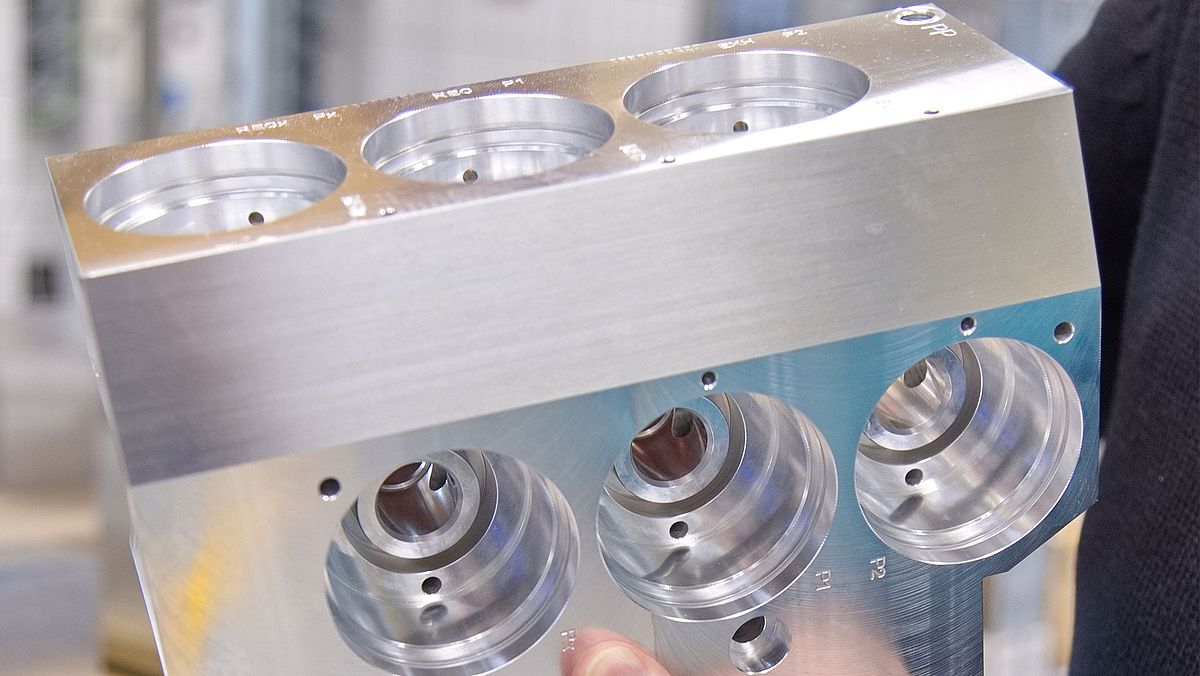
Aluminium accounts for around 90% of the material machined, while some valve components are also produced from chromium-nickel steel. The blanks are geometrically accurate cuboids, precision-sawn to size.
Thomas Girelli: “With this kind of production, you have to understand that every element has to work together perfectly. Nothing can be left to chance. Both the machine tools and the automation system must offer a high level of process stability. But that alone is nowhere near enough. You have to examine every detail and optimise everything you can. It starts with the blanks: they have to be cut precisely to size. That is just one of many crucial elements in this highly refined production process.”
Tobias Fischer comments on the materials: “It sounds simple enough to say that around ten per cent of what we machine is stainless steel. But machining stainless-steel components during lights-out production is a completely different proposition from machining aluminium and places significantly greater demands on both the machine tools and the tooling in terms of process reliability, stability, rigidity and tool life. All of these factors have to be taken into account. Ultimately, the HELLER HF 3500 machining centres have proven to be ideally suited to these demanding requirements.”
Process flow
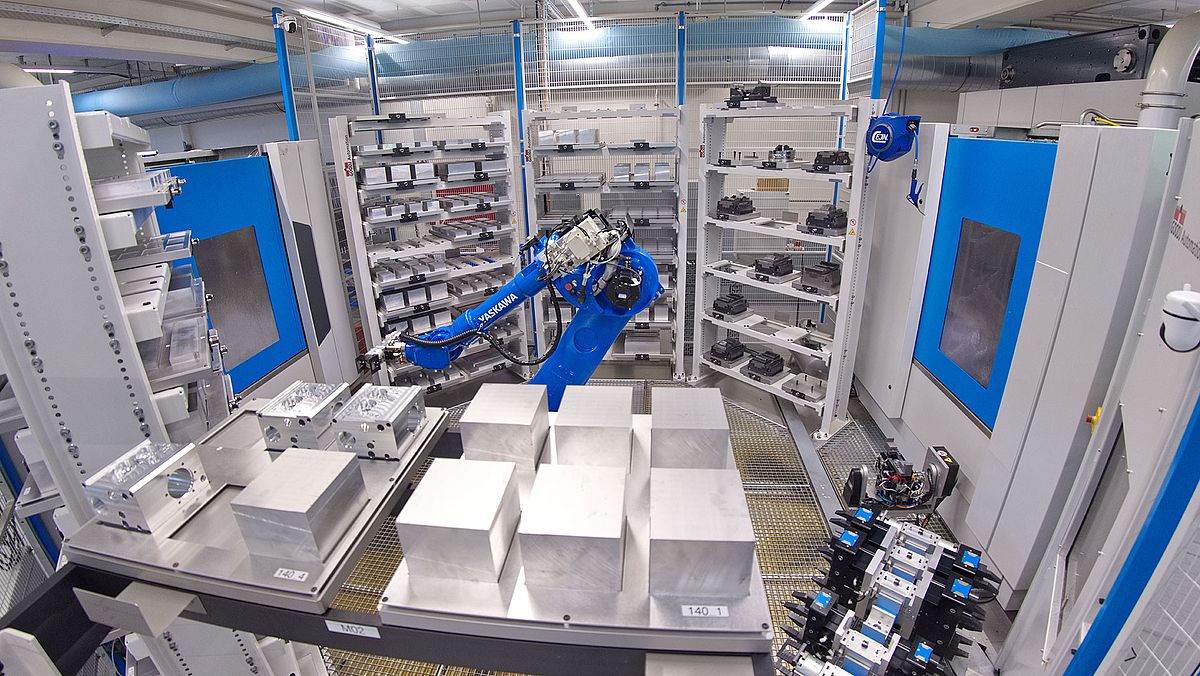
The two manufacturing cells are identical in configuration. In each cell, two HELLER HF 3500 machining centres are linked by a Goodj automation system. An articulated robot is positioned centrally between the two HELLER machines and handles the pallets, workpieces and grippers. All HELLER machines are equipped with a pallet changer that transfers the workpieces from the loading area at the rear into the machining area.
Currently, each manufacturing cell can store enough pallets to support up to 150 hours of unattended production per machine. These are so-called grid pallets, in which the blanks and finished components are placed in defined positions so that the robot can locate them reliably. The pallets are loaded manually with blanks outside the manufacturing cells, then introduced into the cell via a loading station and transferred to the pallet magazine.
When a new batch program is started, the robot retrieves the corresponding pallet containing the blanks from the pallet magazine and transfers it to the handling area. The two machine tools can be used to produce different batches or components, further increasing flexibility.
Once the machining program starts, the robot selects and mounts the appropriate gripper for the component from a total of six available grippers. It removes the blank from the pallet and places it in the clamping fixture, where it is clamped automatically and transferred into the machining area for five-sided machining. After this operation, the component is moved back out, turned over and returned to the machine for finish machining. Once machining is complete, the robot places the finished component back into its defined position on the pallet, which is then returned to the pallet magazine.
The Goodj automation
Thomas Girelli on the Goodj automation system: “For our requirements, the Goodj solution is currently the best option available on the market. It is highly flexible and automatically changes the clamping fixtures to accommodate components of different sizes. It also uses dedicated grippers to position the pallets. If we were producing batches of 500 or more, a different automation solution would be more suitable. However, you always have to assess an automation solution in the context of the overall complexity of the production process.”
Proving out new prototypes
Both manufacturing cells were designed so that new components can be proved out on one HELLER HF 3500 without interrupting production on the other. The design priority was to combine maximum flexibility with high productivity.
Proving out prototypes typically involves several iterations, as Tobias Fischer explains to the SMM editors: “Our design engineers provide us with the CAD data for new components. Thanks to our many years of experience and close collaboration between design and production, the components are designed from the outset with production requirements firmly in mind. Our programmers create the CAM programs and transfer them to the machine for prove-out. It is an iterative process that has to be refined until it is ready for series production. If we identify any design changes that could improve manufacturability, we discuss them with the design team and make adjustments where necessary. Prove-out work is generally carried out on one machine during the day, while the second machine in the manufacturing cell can continue production at full capacity. This is possible because the HELLER machining centre and its CNC control can be accessed directly from outside the manufacturing cell for prove-out work.”
How HELLER machining centres made the shortlist
Tobias Fischer: “We invested in the first HELLER/Goodj manufacturing cell in 2021. The second, identical cell was evaluated in 2024 and installed in 2025. Before making the 2021 investment, we assessed several machine tool manufacturers. Our decision was based both on our own experience and on the experience of companies that use automation to manufacture a similar range of products. We also involve our machine operators closely in the procurement of new machine tools, because they are the people who will be working with the equipment for the next ten years. Our decision-making process therefore relies on close collaboration between production management and the specialists working directly with the machines.”
Thomas Girelli: “Our decision to invest in HELLER machine tools for the first time in 2021 was certainly no coincidence. As we had no previous experience with HELLER machining centres, we sought references from Swiss companies operating in a similar machining environment. If you want to achieve 7,000 production hours per year, machine availability, process reliability and consistent accuracy around the clock – particularly in terms of thermal stability – are critical. Why? Because virtually every component has to meet tolerances of 5µm. The machine has to maintain that level of accuracy for 7,000 hours a year. In fact, the feedback we received from HELLER users about the machines was entirely positive.”
Tobias Fischer adds: “We are talking about two separate investments. When we made the first one in 2021, we had no experience of HELLER machines. By the time we carried out the evaluation in 2024, that had changed. Our excellent experience with our own HELLER machines and Goodj automation led us to choose the same cell concept for the subsequent replacement investment: two HELLER HF 3500 machining centres with Goodj automation. Compared with our previous machine tools, the HELLER machining centres are simply outstanding in terms of process reliability and service support. Their excellent thermal stability is almost a bonus by comparison.”
30% higher productivity
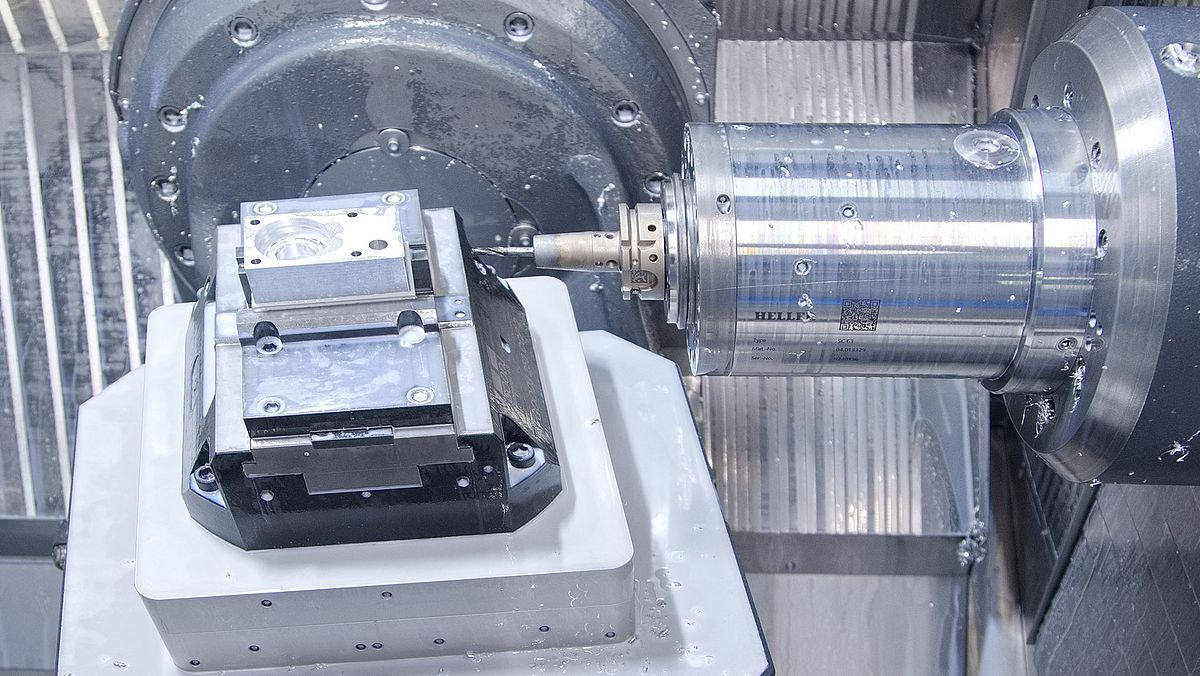
When machining stainless steel in particular, the HELLER machines achieve a significantly higher material removal rate than their predecessors. Both rapid traverse rates and feed rates are higher.
Thomas Girelli: “Overall, the HELLER machining centres alone have increased our productivity by at least 30%. This is where the sturdy, highly rigid construction of the HELLER machines really comes into its own, as is also evident in the surface finish of the workpieces. Even though we machine at higher cutting parameters, there are no chatter marks. The rigidity of the machine has a direct impact on productivity while also delivering better component quality.”
Christoph Andris adds: “I have previously worked for three major German machine tool manufacturers, including as head of a 20-strong team developing special applications. It is important to understand that most machine tool manufacturers design their machines primarily for the automotive industry and its supplier base, where production often involves high volumes. The automation required for this kind of production is also extremely demanding, particularly given the intense cost pressures. Such automation is optimised to the absolute limit, down to fractions of a second. But compared with an automation solution designed for batch sizes of 1 to 20 components, as here at Eugen Seitz AG, high-volume automation is considerably less complex overall. From HELLER’s perspective, what the Eugen Seitz team has achieved is hugely impressive. You do not come across a solution like this very often.”
First 100, then 150 hours of lights-out production
How do you achieve 150 hours of lights-out production? Thomas Girelli explains: “We had already designed the two manufacturing cells to perform extremely well. Achieving 100 hours of lights-out production with small batch sizes and four machining centres running in parallel is impressive in itself. But that still wasn’t enough for our machine operators. They were determined to get even more out of the system. At first, I couldn’t understand why. Then they told me they wanted to be able to go away on a skiing holiday together for a week.”
“That’s what you call intrinsic motivation,” explains Tobias Fischer. “That motivation led them to come up with ideas for extending unattended production even further. And they put those ideas into practice: today, we have reached 150 hours of lights-out production. Given the current constraints, particularly the space available, we have probably reached the limit. But with our people, you can never be entirely sure. They are always coming up with new ideas. It is fantastic to have employees like that.”
Thomas Girelli adds: “To achieve 150 hours of lights-out production, absolutely everything has to be right. For example, there has to be enough raw material available. That is currently our bottleneck, as we simply have no more space for additional pallets. The HELLER HF 3500 machining centres offer an extremely high level of process reliability, which is absolutely crucial. They are also horizontal machining centres, which ensures excellent chip evacuation. This is particularly advantageous for pocket milling and drilling operations, as chips are removed from the machining area more effectively than with vertical machining. Chips are always a challenge during lights-out production and, from a production engineering perspective, their behaviour is difficult to predict.”
Continuous improvement of tool management
Another key factor in the success of the system is having sufficient tool storage capacity and efficient tool logistics. Each of the four HELLER HF 3500 machining centres is equipped with a 240-tool chain-type magazine.
Tobias Fischer: “Our tool management is fully digitalised. All tools are measured automatically on a ZOLLER system, and the resulting data is stored in the system. Each holder carries a Data Matrix code that links it to information such as tool geometry, tool life and location. This means the system knows exactly which tools are available. Reordering is almost entirely automatic. New tools are ordered before the existing ones reach the end of their tool life.”
“And just like that, you’re another 20% faster”
Thomas Girelli: “Tooling is an extremely important factor. We really appreciate it when tool manufacturers show us their latest developments. From our perspective, these discussions always uncover opportunities for improvement, many of which are relatively easy to implement. When tool manufacturers offer us tools that allow us to use higher cutting parameters, we do not hesitate. We adapt the CAM programs, increase the cutting parameters and, just like that, we are another 20% faster when machining a hole, pocket or slot. You have to remain curious and constantly ask yourself how something can be improved. That is the only way to keep moving forward.”
Christoph Andris adds: “The manufacturing specialists at Eugen Seitz AG are genuinely open to new developments in manufacturing technology. From my perspective, this kind of collaboration is exemplary for HELLER as well. It really could not be better.”
Peripheral equipment and coolant system design
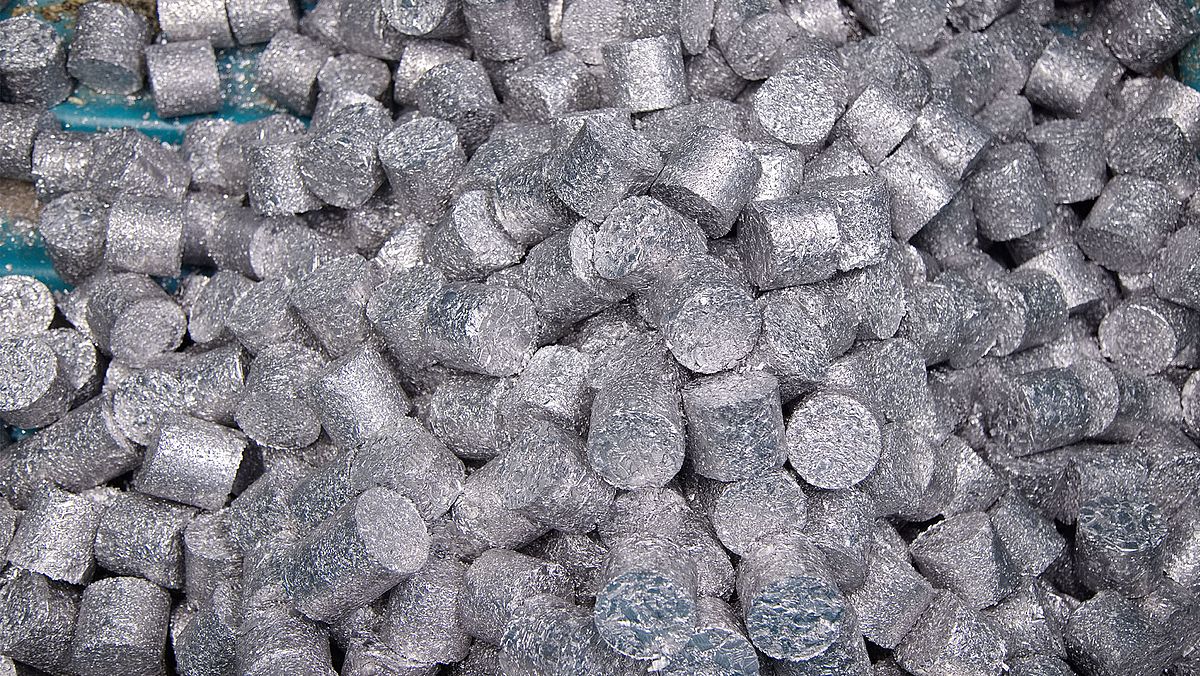
As Thomas Girelli mentioned earlier, all of the peripheral systems play a crucial role in a highly automated process. One example is chip management: “That is why we have integrated a chip briquetting press into every machine tool. Without it, autonomous operation for more than four hours would not be possible. The same applies to the coolant reservoir. It has to be large enough to ensure that coolant losses do not bring the system to a standstill. In ‘normal’ production, such as an overnight lights-out shift, chips and coolant are hardly an issue. They only become a real challenge when you take unattended production as far as we do. Factors like these have to be considered from the outset and built into the system design during the planning phase.”
Zero-defect manufacturing process
When asked by the SMM editors how the components are inspected during lights-out production, Thomas Girelli replies: “The process has been refined to such an extent that the systems effectively produce no scrap. For major issues such as tool breakage or unexpected tool wear, the system is equipped with tool breakage monitoring. Affected components are then removed from the process. Before production starts, we have to make sure that all the tools in use are in perfect condition and that all parameters and tool-life data are correctly stored in the system. The process has to be reliable enough for us to produce good parts continuously for 150 hours. When we measure the parts on Monday morning, the results invariably confirm that we got everything right. The defect rate is below 1%. And we have maintained that level throughout five years of continuous production.”
Rapid commissioning: just eight weeks
Commissioning of the first manufacturing cell went smoothly, but took a little longer, as Thomas Girelli explains to the SMM editors: “Only eight weeks elapsed between delivery and commissioning of the second system. For a system of this complexity, I consider that an excellent result. By comparison, in 2012 it took us a year to get production running with only occasional disruptions.”
Christoph Andris adds: “It was exemplary. The Eugen Seitz team had prepared extremely well in advance. In the end, nothing was missing; they knew exactly what they needed: clamping fixtures, grippers and the necessary peripheral equipment, including the chip briquetting press. Everything simply came together.
Looking to the future
Thomas Girelli is confident about what lies ahead: “We were already running highly automated production in 2012, but it was nothing like the level of refinement we have achieved today. We have worked very closely with Goodj on automation and handling, while choosing HELLER for the machine tools. It is worth noting that Goodj itself also uses a HELLER machine with Goodj automation at its production facility in Sargans. We have found that HELLER and Goodj are an excellent match, not only technologically. And achieving 7,000 operating hours per year on each of our four HELLER machines shows that our assessment was right. That is where things stand today. Once our new building is complete, we will continue to develop our manufacturing operations together with our partners. Whether 7,000 operating hours per year and 150 hours of lights-out production will still be our benchmarks by then remains to be seen. I ‘fear’ that our production specialists may decide they want to go on a two-week skiing holiday together in future.”
At its headquarters in Wetzikon, Eugen Seitz AG employs nine specialists in development, production and sales. A further 20 employees work at the company’s branch in Shanghai, which is responsible for sales and application engineering.
According to Thomas Girelli, the company’s industrial valves serve a range of markets. Eugen Seitz AG is the global market leader in PET bottle stretch blow moulding and supplies all OEMs in this segment. Another important market is valve systems for large diesel engines used in marine, transport, rail and energy applications. A third business area is the growing hydrogen sector, where the valves are used in both stationary and mobile applications. Another business area is natural gas applications, again in the mobile sector.
Thomas Girelli: “Our valves are also used to actuate fuel rods and control rods in nuclear facilities. Safety requirements are very high in all of the sectors mentioned above and particularly stringent in nuclear applications. Our quality management system is designed accordingly.”
Production in Wetzikon to double by 2030
In response to growing demand for its valve systems, Eugen Seitz AG plans to double production output at its Swiss site by 2030. Thomas Girelli: “We are currently planning a new building to make this possible. But even then, the space available will be limited, so we have to maximise productivity per square metre in order to achieve a commercially viable result.”